




The Blessing of Mother Paraskeva
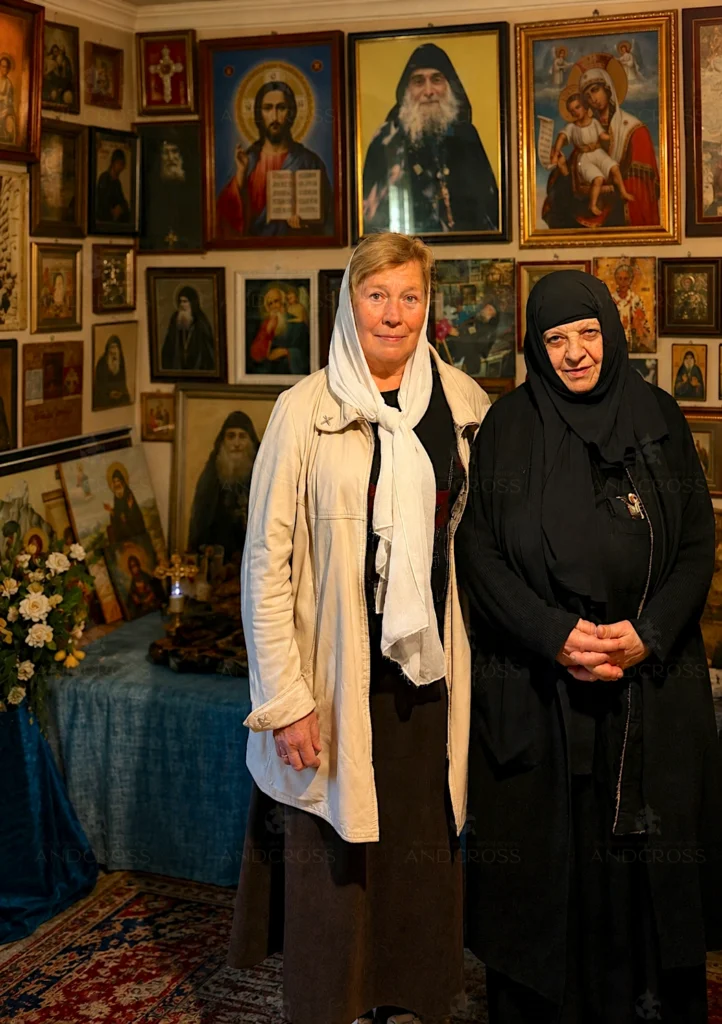
Members of the NiKa Association for People with Disabilities who take part in our pilgrimage journeys have the opportunity to receive the blessing of Mother Paraskeva, who served for many years as the cell attendant of Saint Gabriel Urgebadze.
With a blessing, she makes the sign of the Cross over each pilgrim using a vial containing the incorrupt blood of Saint Gabriel, which she reverently preserves as a precious holy relic.
This sacred relic is connected with Saint Gabriel and is venerated by Orthodox Christians as a testimony to his holy life. For members of the NiKa Association, receiving this blessing becomes one of the most moving and memorable moments of the pilgrimage, strengthening them in faith and hope and giving them spiritual support.
Saint Gabriel Urgebadze in the Recollections of Mother Paraskeva
Based on the recollections of Mother Paraskeva Rostiashvili, who served for many years as the cell attendant of Saint Gabriel Urgebadze
Love That Transformed People
Father Gabriel possessed a rare gift: through his sincere and self-sacrificing love for Christ and for people, he drew to himself everyone who crossed the threshold of his cell. In his presence, formalities and distances between people disappeared. He taught not so much through words as through his own life, offering an example of humility, obedience, and complete trust in Divine Providence.
Humility: The Path to the Kingdom of Heaven
The chief virtue to which Father Gabriel constantly called his spiritual children was humility.
“Every trial will pass by the humble person. The Lord gives grace to the humble, and without humility no one will enter the Kingdom of Heaven.”
These words were not merely instruction. Father Gabriel would sometimes arrange particular spiritual trials for those close to him, testing the sincerity of their obedience and their ability to accept circumstances humbly. Only years later did many understand the deeper meaning of those lessons and realise with what love he had guided each person towards salvation.
Faith Confirmed by Works of Mercy
The saint also frequently reminded people that true faith is impossible without acts of mercy.
“The Lord asks of us both our heart and our good deeds. Whatever good you have done for your neighbour, you have done for Me.”
Father Gabriel repeated these Gospel words especially often, urging people to see the image of God in every human being.
What True Fasting Means
One day a priest asked Father Gabriel:
— Father, what is true fasting?
— I shall explain it now, he replied calmly.
Instead of offering a lengthy explanation, the saint reminded the priest of sins he had committed since his youth. On hearing this, the priest became deeply troubled, could not restrain his tears, and sincerely repented.
A little later, Father Gabriel unexpectedly invited him to eat something.
— How can I eat now? the priest answered. — My soul feels so heavy…
Then Father Gabriel said lovingly:
“This is true fasting. When a person sees his sins, repents, and turns to God with all his heart, thoughts of food naturally fall into the background.”
In this way, he taught that the meaning of fasting lies first of all in the purification of the heart, and not merely in abstaining from non-fasting foods.
Love Is Higher Than Human Rightness
On the eve of Great Lent, Father Gabriel would always kneel before the ambo in the Church of the Transfiguration and pray fervently, asking the Lord to forgive his sins.
If, for someone’s spiritual benefit, he had to rebuke a person sternly and that person did not come to be reconciled before the end of the day, Father Gabriel himself would go to them and be the first to ask forgiveness.
In this way he showed that love and humility are always higher than being right in human terms.
Mother Paraskeva’s Spiritual School
Mother Paraskeva recalled that the years she spent beside Saint Gabriel changed her inner life forever. Worldly thoughts gradually lost their power, while the desire for prayer, compassion, and a longing to live according to Christ’s commandments took their place.
She felt that Father Gabriel guided her spiritual life quietly yet with extraordinary wisdom. At times her heart was filled with such lightness and joy that every earthly burden seemed to disappear. At precisely such moments, he would gently lead her back to humility, preventing her from falling into spiritual self-confidence.
There were other days as well. When sorrow became especially heavy and it seemed that the soul could no longer endure the trials, Father Gabriel always found words of consolation.
With a kindly smile, he would say:
“Endure, endure, Mother. The one who endures to the end will be victorious.”
The Blessing of Expectant Parents
One day a married couple came to Father Gabriel for a blessing. The young woman was expecting a child. He spoke with them for a long time, urging them to build their family life upon love, mutual respect, and Christian peace. He especially asked them to avoid irritation, harsh words, and quarrels.
— Be careful about what you say, he instructed them. — The child can already hear you and perceives everything that is happening around it.
The husband looked at Father Gabriel doubtfully and objected:
— Father Gabriel, how can that be possible? Sometimes one cannot hear a conversation through a wall, yet you say that a child hears everything while still in its mother’s womb?
Father Gabriel smiled calmly.
— So you do not believe?
Then, turning towards the expectant mother, he said loudly:
— Child, I am speaking to you. Do you not hear the word of God?
A Miracle Witnessed by the Parents
At that very moment, the child moved so strongly in the mother’s womb that the woman instinctively grasped her stomach and, deeply shaken, hurried out of the cell.
For the couple, this became convincing testimony that human life begins long before birth and is already capable of perceiving the surrounding world.
“I Would Not Exchange My Georgia for Mount Athos”
One day monks from the Holy Mountain of Athos visited Saint Gabriel. As he saw his guests off, Father Gabriel gave one of them an icon of the saint whose name he bore.
The gift moved the monk deeply. Falling to his knees, he earnestly begged Father Gabriel to move to Mount Athos, assuring him that every condition would be provided there for a peaceful monastic life.
Father Gabriel, however, answered only quietly:
“I would not exchange my Georgia for Mount Athos.”
The guest was the abbot of the Monastery of Xeropotamou. In these simple words, Saint Gabriel revealed his boundless love for his native land and his people, to whom he devoted his entire life.
A Face Illuminated by Uncreated Light
Mother Paraskeva recalled an event that remained in her memory forever.
One evening, at about six o’clock, she was in the cell beside Father Gabriel. Suddenly he asked her to leave.
— You must not look at me now, he said quietly.
Obediently making her way to the door, she involuntarily glanced back. At that moment she saw an extraordinary sight: the saint’s face was shining with an otherworldly light, as though illuminated by brilliant rays of the sun.
The vision was engraved so deeply upon her heart that she remembered it throughout her life.
The Rescue of a Woman from Robbers
Once a woman came to Father Gabriel and, scarcely having crossed the threshold of his cell, said with great emotion:
— You saved me from death. Please allow me at least to thank you.
She then told her story.
She lived in a small house near a cemetery. One night armed bandits broke into her home. In despair, she began fervently calling upon Father Gabriel for help.
According to her account, a true miracle occurred. Father Gabriel suddenly appeared before the attackers holding a club and rushed resolutely towards them. Terrified, the criminals fled in panic, while the saint disappeared just as suddenly as he had appeared.
For the woman, this event remained a living testimony to God’s protection through Father Gabriel’s prayers.
An Unseen Visit to the Shavnabada Monastery
Despite his serious illness, Father Gabriel often spoke about events as though he had been personally present at them.
One day he suddenly said:
— I am going to the Shavnabada Monastery now.
Mother Paraskeva thought that he was speaking figuratively, but after some time she nevertheless asked:
— Father, were you in Shavnabada?
— I was, Father Gabriel answered calmly. — When I arrived, the brotherhood was having its meal. Everything is well with them.
— Did no one see you?
— No. If they had seen me, they would have been surprised. Besides, I did not wish to show myself.
— And what was Father Shio doing?
— Counting the people.
Several days later, Archimandrite Shio, the abbot of the Shavnabada Monastery, did indeed come to the cell.
During their conversation, Mother Paraskeva asked him:
— Are there many brothers in the monastery at present?
The archimandrite smiled and replied:
— It is difficult to say. Some come and others leave. I usually count everyone during the meal.
After these words, Father Gabriel merely gave Mother Paraskeva a meaningful look and remained silent with a kindly smile.
For her, this became yet another testimony to his extraordinary spiritual gifts.
Prayer for Georgia
When his illness became much worse, Father Gabriel asked to be taken to the church.
Kneeling before the icon of the Most Holy Theotokos, he prayed for a long time with tears in his eyes:
“Accept me as a sacrifice, Mother of God, but save my Georgia.”
Love for his homeland was inseparable from his entire spiritual life.
Mother Paraskeva recalled that whenever his sorrow over the fate of his native land became especially intense, Father Gabriel asked her to sing a lullaby softly. At those moments, his prayer for Georgia was particularly fervent and profound.
He often repeated:
“Woe to the monk or priest whose heart does not suffer for his people.”
Love for Those Who Cause Pain
Mother Paraskeva recalled that Father Gabriel treated all people with the same love, regardless of how they behaved towards him.
Instead of gratitude for his kindness, he was often met with mockery, insults, and humiliation. One day, unable to hide her astonishment, she asked:
— Father, do you still continue to love them even now?
He answered with quiet sorrow:
“Now I pity them even more and love them even more deeply.”
These simple words revealed the full depth of his Christian mercy. In every person, he saw first of all a suffering soul in need not of condemnation, but of love and compassion.
The Heart of a Monk
Father Gabriel never allowed people to wait long to see him. He believed that care for one’s neighbour begins with the simplest things.
“How can you calmly attend to your own affairs while someone is waiting for you? The heart of a true monk must be as sensitive as the heart of a loving mother.”
The door of his small cell was open to everyone. Monks, clergy, laypeople, children, and the elderly all found consolation and wise counsel there.
He sought to reveal to each person the beauty of God’s love and to remind them of the supreme purpose of human life.
“The heart can be strong even when the body is weak. Do not care only for the body; above all, save the soul. Whoever learns to overcome gluttony and idle talk has already entered the right path. Seek first the Kingdom of Heaven, and everything necessary will be added to you.”
When Prayer Remains Fruitless
One day Father Gabriel asked us an unexpected question:
— How do you understand the words, ‘Prayer will be counted as sin’?
We began to offer our suggestions.
— Perhaps the person prayed incorrectly.
— No, Father Gabriel replied calmly.
— Perhaps the prayer was insincere?
— No. It came from the very heart.
— Then perhaps the person prayed without attention?
Father Gabriel smiled.
— Do not imagine that you have already attained holiness. Distraction is familiar to every human being.
We could not find the right answer and asked him to explain the meaning of the words.
— You will understand now, he said.
At that moment, a young man entered the cell to receive a blessing. Father Gabriel asked him to help with something, but the young man said that he was busy.
— I cannot do it now. Perhaps later, if I have time.
Watching him leave, Father Gabriel said quietly:
“Now he will pray for a long time, perhaps for five hours without interruption. But will the Lord accept such prayer if a person has refused to help his neighbour? As long as you do not fulfil God’s commandments, do not imagine that lengthy prayers alone will draw you closer to God. Without works of love, prayer remains fruitless. Good deeds open the doors of the Kingdom of Heaven, humility leads a person into it, and love enables one to behold God. If prayer is not followed by works of mercy, that prayer becomes dead.”
Do Not Judge Your Neighbour
These words entered deeply into our hearts and became a true lesson in spiritual life.
To show how dangerous the sin of judgement is, Father Gabriel related an incident from his own life.
— One day in the altar, people were speaking about a priest who suffered from alcoholism. I too allowed myself to condemn him in the presence of the Patriarch, although I did not know the man at all. Deep within me, I wanted to display my own righteousness.
Some time later, while at home, he suddenly felt the desire to drink wine. After drinking only one glass, he went to Sioni Cathedral.
— When I entered the altar, I felt severely intoxicated. My legs gave way, I stumbled, and nearly fell. His Holiness managed to support me. It seemed that no one noticed anything, but for me it became a clear lesson from God.
After a short pause, Father Gabriel said:
“With the judgement by which you judge another, you will yourself be judged. When you condemn a person, remember that by doing so you rise up against God Himself.”
A Blessing That Saved a Life
One day a young man came to Father Gabriel. The saint looked at him attentively and suddenly said:
“I cannot see your soul. Go at once and receive the Holy Mysteries of Christ. May Divine grace preserve you.”
Without hesitation, the young man obeyed the blessing and received Holy Communion that same day.
That evening, his friends invited him to a gathering, but he declined because he wished to preserve the reverence of Communion. Another young man went in his place and was tragically killed in a car accident that very evening.
Mother Paraskeva remembered this event as yet another sign of how deeply Father Gabriel perceived the spiritual state of a person and how lovingly he sought to protect everyone from harm.
The Lord Averted Disaster
During a visit to a family, Father Gabriel noticed a young man. Looking at him attentively, he said quietly:
“Child, a serious trial lies ahead of you. Come to me. I shall bless you, and the Lord will avert the disaster.”
Trustingly, the young man approached Father Gabriel and received his blessing.
Some time later, he was accidentally struck by a bullet. It only grazed him and caused no serious harm. Everyone was convinced that, through Father Gabriel’s prayers, the Lord had preserved his life and turned away mortal danger.
Mercy Is More Important Than Outward Piety
Mother Paraskeva recalled another event that affected her deeply.
After the Divine Liturgy, parishioners were leaving the church, having just received Holy Communion and the grace of God. Yet when some of them noticed a homeless dog near the church fence, they began throwing stones at it.
Father Gabriel watched with profound sorrow and then said quietly:
“It would be better for such people not to come to church at all than to stand at the service merely pretending to pray.”
These words were addressed not only to those people but to everyone who forgets that genuine faith is revealed first of all in mercy and love towards every creature of God.
A Trial of Humility
Father Gabriel’s favourite place was the top step of the staircase leading to the tower. There he often spoke with people or simply prayed.
One day, a priest whom he knew was climbing the stairs. Looking at Mother Paraskeva, Father Gabriel said with a smile:
— Would you like me to shake him up now?
Before she had time to understand what he meant, Father Gabriel suddenly addressed the priest with very harsh words. To an observer, it looked like a severe trial.
The priest stopped, bowed calmly, and answered humbly:
— Father Gabriel, I am far worse than anything you have said about me.
At once, Father Gabriel’s face lit up with joy. He embraced the priest firmly and said:
“Now I see that you are truly my brother.”
In this way, Saint Gabriel often tested people, revealing the true condition of their souls. He valued humility above every outward virtue.
Do Not Judge by Appearances
At times, Father Gabriel deliberately concealed his spiritual struggles beneath the appearance of ordinary human weakness.
He would sometimes carry a jug of wine out of his cell, cover it with a towel, and pretend that he was trying to hide it. In this way, he allowed those who were inclined to judge others hastily to reveal their own thoughts.
It was important to him to teach people not to condemn their neighbour on the basis of outward appearances.
Foreknowledge of Future Events
One day Father Gabriel unexpectedly said to those close to him:
“When I depart to the Lord, do not place me in this coffin. Leave it for my mother. Sometimes a person has to be buried on the very same day.”
At the time, no one understood the meaning of his words, but Mother Paraskeva remembered them.
Five years passed after Father Gabriel’s repose. His mother, the nun Anna, fell asleep in the Lord late in the evening on Great Wednesday. The very next day, with the blessing of His Holiness the Patriarch, she was buried.
At that moment, Mother Paraskeva remembered Father Gabriel’s words and understood that he had foreseen these events beforehand.
A Prophetic Word
During the monastic tonsure of one of the sisters, Father Gabriel said with extraordinary sorrow:
“Child… How deeply I grieve for you. You are taking upon yourself a very difficult cross.”
Only years later did those around her understand the meaning of these words. The nun was unable to endure the trials of monastic life and left the monastery, returning to the world.
A Sermon from the Theatre Stage
Despite the strictness of his ascetic life, Father Gabriel loved the Georgian opera “Daisi” and occasionally went to the theatre. He was particularly moved by the scene in which the Patriarch blesses the people.
Although it was only an actor appearing on stage, Father Gabriel stood every time as a sign of profound respect for the episcopal office.
On one occasion, the performer was so unsettled by this unusual display of reverence that the performance had to be paused briefly.
Taking advantage of the pause, Father Gabriel went up onto the stage and addressed the audience with an inspired sermon about Christ, calling everyone to reflect on the salvation of their soul.
Peace in the Family
Once a young woman came to Father Gabriel and tearfully told him that quarrels in her family never ceased and that her brother, unable to endure the constant conflict, had left home.
Without delaying for a moment, Father Gabriel went with her.
The Prayer That Restored Peace to a Family
When they entered the house, they discovered that the brother had already returned.
— I do not know why, he admitted, but some invisible force compelled me to come back.
Father Gabriel went to the household icons and began to pray fervently.
The young woman later recalled:
“I saw the icon of the Most Holy Theotokos become illuminated by an extraordinary light, which shone upon Father Gabriel’s face. His prayer was so powerful that every trace of hostility seemed to disappear from our home. From that day onward, peace, harmony, and calm of soul reigned in our family.”
What True Love Is
One day Father Gabriel asked a man:
— Tell me, what does true love mean to you?
The man answered confidently:
— Love is when someone shoots at your neighbour and you shield him with your own body.
Father Gabriel looked at him attentively and said quietly:
“That too is a courageous deed. But love begins much earlier. If your neighbour becomes ill and, in order to save him, you must make a long journey, forgetting exhaustion and danger so that you can bring him medicine, that is genuine love. Love is revealed in daily care, self-sacrifice, and readiness to serve another person.”
With these words, Father Gabriel again reminded people that love is not only a heroic act performed in exceptional circumstances, but above all a constant service to one’s neighbour in everyday life.
Seek First the Kingdom of Heaven
Father Gabriel tirelessly repeated to his spiritual children:
“Seek first the Kingdom of Heaven.”
One day someone asked him:
— Father, how should a person seek the Kingdom of Heaven?
He answered simply and yet profoundly:
“When you sit down at the table, remember those who are hungry today, those who suffer and thirst. Do not forget to pray. Sincere prayer can move mountains.”
With these words, Father Gabriel taught people to see beyond their own concerns to the pain of others, and to unite prayer with works of love and mercy.
A Vision of the Salvation of the World
One day Father Gabriel shared an extraordinary vision with us.
— It was revealed to me, he said, that the Lord was holding the globe in His hands, and above it stood a great Cross. Then I asked:
— Lord, how will people be saved before the Second Coming?
And he heard the answer:
“People will be saved by kindness and love.”
Saint Gabriel often recalled these words, reminding us that love for God and for one’s neighbour will be the greatest test of the human heart.
The Final Days of His Earthly Life
“I Am Going to Pray for You”
Shortly before his repose, just before going to sleep, Father Gabriel suddenly pointed towards a corner of the cell and said quietly:
“Death is standing there. It is already waiting for me. But I am not going in order to abandon you. I shall go to pray for you and carry your prayers before the Lord.”
Mother Paraskeva remembered that these words were spoken calmly and without the slightest fear. Father Gabriel spoke about passing into eternity as naturally as a person speaks about an approaching journey.
The Crown of Thorns
Two weeks before his repose, Saint Gabriel was given an icon of the Holy Face of the Saviour, upon which Christ was depicted wearing the crown of thorns.
Mother Paraskeva said hopefully:
— Father, when you were given the icon of the Mother of God, your condition improved noticeably. I believe that now you will recover completely.
Father Gabriel merely shook his head.
“If the Saviour had been depicted without the crown of thorns, I truly would recover. But this crown speaks of something else. It means that I must walk a path of suffering.”
Some time later, Mother Paraskeva noticed an unusual change: the eyes of the Saviour on the icon, which had previously been closed, seemed to open.
She hurried to tell Father Gabriel.
After listening to her, he said calmly:
“In three days you will learn of my repose.”
Everything happened exactly as he had said.
The Last Night
Three days before his departure, Mother Paraskeva prayed fervently to the Most Holy Theotokos for Father Gabriel’s recovery. That night she was granted a consoling vision. The Mother of God told her that she would come in three days and heal Father Gabriel completely.
When Mother Paraskeva told him about this, he asked:
— Stay beside me tonight. Do not sleep; let us talk.
She sincerely tried to fulfil his request, but human strength failed her. Without noticing it, she fell asleep.
When she awoke, she saw that Father Gabriel was still keeping vigil.
— You promised that you would not fall asleep, he said quietly.
These words touched Mother Paraskeva deeply, and she felt bitter sorrow at her own weakness.
The Final Blessing
At about four o’clock in the morning, Father Gabriel called out weakly:
— Mother… sister…
She came to him immediately.
Tears were flowing down his face. Mother Paraskeva knelt before him.
Father Gabriel blessed her and then slowly made the sign of the Cross over Georgia, as though blessing his entire native land from every side.
Afterwards, he looked lovingly around his small cell and, without taking his eyes from the icon of Saint Nicholas the Wonderworker, entered into deep prayer.
Mother Paraskeva recalled:
“At that moment, an extraordinary feeling took hold of my heart. It seemed that the whole cell had been invisibly filled with the presence of the Angels of God.”
The Peaceful Repose of the Saint
By evening, Bishops Daniel and Michael arrived. They read the prayers at the departure of the soul.
With a quiet, radiant smile, Father Gabriel looked upon everyone who had gathered, as though bidding farewell to each person, and peacefully surrendered his soul to the Lord.
Mother Paraskeva recalled that this moment did not resemble an ordinary human death. Instead of grief and despair, the heart was filled with extraordinary peace, light, and love. There was no fear of separation; on the contrary, the soul overflowed with quiet joy, recalling both the celebration of the Nativity of Christ and the light of the Resurrection.
In Place of an Afterword
This is how Saint Gabriel remained forever in Mother Paraskeva’s memory: a man of boundless love, profound humility, and unshakeable faith, who dedicated his whole life to God, to his people, and to everyone in need of consolation.
Source
Based on the recollections of Mother Paraskeva Rostiashvili, who served for many years as the cell attendant of Saint Gabriel Urgebadze.
Translated from Georgian by: Konstantin Tsertsvadze and Mariami Gorgadze.