



The Saint’s Physician
Dr Zurab Varazi’s Revelations About Saint Gabriel (Urgebadze)
A Saint Known During His Lifetime
In December 2012, the Georgian Orthodox Church canonised Archimandrite Gabriel (Urgebadze), a confessor of the faith and fool-for-Christ who lived in the twentieth century.
Elder Gabriel (1929–1995) was our contemporary, a man whom many people still remember personally.
Among those who knew the ascetic especially well was the surgeon Zurab Georgievich Varazi, who served as his attending physician.
Looking back on the elder’s life, the doctor later said that even while Father Gabriel was still alive, many people sensed that they were in the presence of a man of holy life and that one day the Church would surely confirm it.
After the canonisation, the doctor understood even more deeply how extraordinary the gift entrusted to him by God had been. People usually pray to saints whom they never saw during their earthly lives, whereas he had not only known Saint Gabriel personally but had also treated him as a physician.
According to the doctor, such a living encounter with a saint remains in the human heart forever.
First Encounters at Sioni Cathedral
The story of the saint’s life, his final days, his spiritual guidance, and the many occasions on which he helped others is told by the surgeon Zurab Georgievich Varazi, Chairman of the Social Department of the Georgian Patriarchate.
The doctor recalls that he first saw Father Gabriel at Sioni Cathedral, which at that time served as the cathedral church of Tbilisi.
The elder immediately drew attention because of his unusual appearance. Large icons of the Mother of God and Saint Nicholas the Wonderworker hung on his chest beside his cross.
At times he preached to the people, at times he spoke loudly about the spiritual life, and at other moments he stood in church with tears in his eyes, wholly absorbed in prayer.
His unusual manner both attracted people and filled them with reverent awe.
Whenever Father Gabriel entered the church, parishioners hurried to receive his blessing.
As he blessed someone, he placed his hand on the person’s head and quietly said:
“May the Lord Christ bless you.”
After these words, he embraced the person with special warmth and love.
The Beginning of My Medical Service
At that time, I knew almost nothing about Father Gabriel’s life—neither where he served nor where he lived.
Later, the elder suffered a severe injury: a fracture of the femoral neck. Serious complications followed, including gastric bleeding and dropsy. His condition deteriorated rapidly, and those close to him were deeply concerned.
Many tried to persuade him to see a doctor, but for a long time he refused medical assistance.
One day, a relative told Father Gabriel about me—that I was a surgeon, served under the Georgian Patriarchate, and had visited the Holy Mountain of Athos.
He then cautiously asked:
— May we bring him to you?
The elder calmly replied:
“If God blesses it, let him come.”
My First Visit to His Cell
When I arrived in Mtskheta and entered Father Gabriel’s small cell, I was struck by its extraordinary atmosphere.
Every wall, from floor to ceiling, was covered with icons. It felt as though one had crossed the threshold not of an ordinary room, but of an entirely different world.
I immediately approached him for a blessing.
After blessing me, Father Gabriel smiled and said:
“See, you asked for a blessing at once. Other doctors barely cross the threshold before they begin asking, ‘What hurts?’ But I am a monk—what could possibly trouble me?”
That, he said, was how he usually answered:
— Nothing.
Prayer Before Every Treatment
After examining him, it became clear that the elder needed serious medical care.
The accumulated fluid had to be removed, tests had to be carried out, and he needed a blood transfusion.
This was how our regular meetings began. At times, I visited him every day.
Once, before a procedure, I was disinfecting my hands, as I always did before surgery, and quietly reciting a prayer.
Father Gabriel looked at me attentively.
— What are you whispering?
— A prayer, Father.
— Which one?
— The Lord’s Prayer.
He then asked me to recite it aloud.
After that, he told me to read a prayer to the Most Holy Theotokos and Psalm 90.
When the prayers were finished, Father Gabriel calmly said:
“Now begin your work.”
Whoever Thanks a Doctor Thanks God
After the procedure, Father Gabriel said joyfully:
“You are doing God’s work.”
He then asked Mother Paraskeva to bring money for the doctor.
I strongly protested:
— Father, how could I accept money from you? Besides, I serve under the Georgian Patriarchate, and we treat clergy without charge.
But the elder gently stopped me:
“I decide here, not you. Whoever does not thank a doctor does not thank God.”
Seeing my embarrassment, he affectionately stroked my head and quietly added:
“Dear doctor, a physician’s work is God’s work. The Lord Himself acts through the hands of the doctor. Therefore, to thank a doctor is to thank God.”
“You Already Have One Foot There”
One morning, I felt unwell: my blood pressure rose and I developed pain in my heart.
When I began to feel a little better, I went to see Father Gabriel.
The moment he looked at me, he said:
“Everyone is afraid of death. Yet death is only a brief moment, a passage into another life. A person has barely closed his eyes here before his spiritual eyes are opened. He sees his body from outside and thinks: why should I return to it? Without it, everything feels so light and free.”
I replied that after seeing so much death during my years of medical practice, I had long ceased to fear it.
Smiling, Father Gabriel said:
“And do you know that you already have one foot there?”
Alarmed, I asked:
— Have you noticed something serious?
The elder smiled again.
“You see? Fear still lives in you after all.”
After a short pause, he continued:
“Every good deed brings a person closer to God, and every evil act takes him farther away. Our whole life consists of these steps—upward or downward. Therefore, strive to live in such a way that you are always ascending towards the Lord.”
Wisdom Born of Spiritual Experience
I was always amazed by the depth of Father Gabriel’s thoughts.
It seemed incredible that a man with such spiritual understanding of the world had received so little formal education.
Later, I learned that he had not even completed several years of school.
And yet his words possessed such inner power and depth that it seemed he drew his knowledge not from books, but directly from living communion with God.
When the Elder Spoke with God
One day, we were sitting beside Father Gabriel, talking and even joking.
Suddenly, everything changed.
The elder fell silent, raised his hands towards the icon of the Saviour, and became completely absorbed in prayer.
His face was transformed, and his gaze seemed no longer to belong to this world.
I quietly asked Mother Paraskeva:
— What is happening?
She immediately stopped me:
— Quiet… do not disturb him.
He remained like this for about fifteen minutes.
Then he slowly lowered his hands crosswise upon his chest and spoke words that have remained in my memory forever:
“The Lord is coming. Before Him, the whole universe trembles. The time of earthly life is drawing to its end. People think that the familiar bustle of life will continue forever, but it will not. Everything has its limit. And you will yet become witnesses to this.”
We were shaken by what we had heard.
But, as though wishing to calm us, Father Gabriel continued more gently:
“The most important thing is to live according to God’s commandments. Learn to love one another and preserve love for your neighbour. I will carry your love and your good deeds before the Lord.”
The Final Days
A few days before his repose, Father Gabriel allowed us to take blood for tests.
When I told him about it, he smiled and asked:
— Why do you need this blood?
I explained why the tests were necessary.
But the elder only smiled:
“I do not need your tests and haemoglobin counts.”
Then I quietly said:
— Father Gabriel, if something happens to you and I fail to do everything necessary, it will weigh heavily on me before God.
Hearing this, he replied:
“Well, if that is so, take as much as you need, so that the Lord will not reproach you.”
We drew the blood, not yet realising that it would later become a great holy relic.
“I Am Tired…”
The next day, the elder’s condition deteriorated sharply.
We urged him to agree to an operation and promised to perform it right there in his cell, bringing all the necessary equipment.
But Father Gabriel firmly refused.
With profound weariness, he said:
“Since the age of twelve, I have followed the Lord. I am tired. May the Lord receive my soul.”
These words pierced my heart.
It was difficult for me to accept that nothing more could be done for a man whom I had come to love sincerely.
I went to His Holiness Patriarch Ilia II.
After listening carefully, he calmly said:
“He himself said, ‘I am tired, Lord.’ You have done everything possible. Monks cannot be treated by force. God’s will be done in all things.”
The Last Meeting
Soon afterwards, I was urgently called back to the cell.
When I entered, Father Gabriel lay motionless, his gaze fixed upon the icon of Saint Nicholas the Wonderworker.
I wanted to ask whether anything was troubling him.
But with a single glance, he made it clear:
“Do not disturb me…”
The Final Hours of His Earthly Life
Late in the evening, Bishop Daniel arrived and read the prayers for the departure of the soul.
As soon as the prayer ended, a quiet, radiant smile appeared on the elder’s face. A slight tremor passed through his body, his heart stopped, and Father Gabriel peacefully departed to the Lord.
The Incorrupt Blood of the Saint
An Extraordinary Discovery Four Years Later
Several years after Father Gabriel’s repose, a colleague unexpectedly telephoned me.
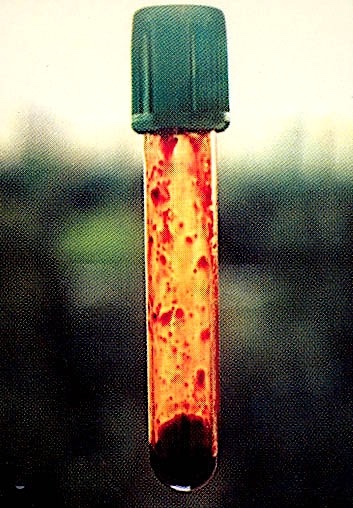
While sorting through old belongings during renovations, he had accidentally found a test tube containing the elder’s blood, which had been drawn four years earlier.
In an agitated voice, he said:
— You will not believe it, but the blood looks as though it were taken only recently.
We immediately decided to examine it.
To my astonishment, the blood had been preserved in an unusual way: it had neither clotted nor dried out, and it showed no signs of decomposition.
I carefully took a small drop, prepared a smear, and sent it for analysis.
The results were remarkable—the indicators were almost normal.
When the specialists were told that the blood was already four years old, they simply refused to believe it.
We ourselves could not explain what had happened.
The test tube was shown to the head of the Department of Pathological Anatomy.
She admitted:
“In all my years of practice, I have never encountered anything like this, nor have I ever read of such a case in the medical literature.”
On her advice, the sample was anonymously sent to the Blood Transfusion Institute.
The conclusions there were almost identical: the blood had remained in satisfactory condition, with only minor cellular changes.
The Patriarch’s Blessing
After this, I went to His Holiness Patriarch Ilia II and told him everything that had happened.
His Holiness listened attentively and calmly said:
“Let us wait. If this is truly a sign from God, the Lord Himself will reveal the truth.”
He blessed us not to destroy the blood, but to bury it near the elder’s resting place.
Thus, the test tube was buried beside Saint Gabriel’s grave at Samtavro Monastery.
Later, when thousands of pilgrims began coming to the grave, Mother Paraskeva decided to remove the test tube from the earth and preserve it as a holy relic.
The Glorification of the Saint
The miracles and numerous healings that occurred through Father Gabriel’s prayers after his repose increasingly convinced us that he had indeed been a man of truly holy life.
Therefore, the news of his canonisation did not come as a surprise, but as confirmation of what we had long felt in our hearts.
When the Georgian Orthodox Church glorified Gabriel (Urgebadze) among the saints, I experienced a very special feeling.
Usually, we pray to saints whom we never knew personally.
But in this case, everything was different.
I had seen him during his lifetime, spoken with him, treated him, and even performed a minor operation on him.
The awareness that a person with whom you shared a living human relationship has now been glorified by the Church as a saint remains in the heart forever.
The Saint’s Help After His Repose
Unexpected Help on the Road
I constantly feel the spiritual closeness of Saint Gabriel.
In difficult moments, he is the first person to whom I turn in prayer.
And more than once, I have become convinced that he hears me.
One day, my car broke down in the middle of a deserted road.
The engine stopped, there was no one around, and I had no idea how I would get home.
Then I looked at a calendar lying beside me with a photograph of Father Gabriel and said inwardly:
“Father Gabriel, help me.”
Almost immediately, a Mercedes stopped nearby.
A man got out and calmly said:
— Let me help you.
He repaired the car himself, then towed it and drove me all the way home.
To me, this was not a coincidence, but another sign of the saint’s living help.
The Healing of My Father
An event involving my own father strengthened my faith especially deeply.
He was eighty-nine years old when he suffered a volvulus.
A serious complication developed after the operation.
I was already preparing for a second surgical procedure.
At that moment, I remembered that I had some oil from the lamp burning at Saint Gabriel’s grave.
I prayed and, while anointing my father’s abdomen, quietly said:
“Father Gabriel, I once helped you—now help my father as well.”
Only about fifteen minutes passed.
My father called me.
The dressing was soaked—the bowel had begun functioning again.
His condition improved sharply, and a second operation was no longer necessary.
Later, the professor asked in astonishment:
— What kind of oil was that?
I replied:
— Ordinary oil from the lamp at the elder’s grave.
He reacted sceptically.
But for me, what had happened was a true miracle.
I am convinced that through the prayers of Saint Gabriel, the Lord granted healing to my father.
A Confessor of Christ
His Struggle During the Years of Persecution
Father Gabriel himself told us about the event after which his name became known throughout Georgia.
It happened in the 1960s, during the severe persecution of the Church.
During a festive demonstration on 7 November, he set fire to a huge portrait of Lenin displayed on the Government House building.
As he carried out this act, he said:
“Lord Jesus Christ, I am coming to You.”
The flames quickly engulfed the portrait.
Later, Father Gabriel said that he rejoiced not in the fire itself, but in the fact that people were forced to trample upon the image of the idol of their age.
“I Myself Am a Cross”
After his arrest, his crosses and icons were taken away.
Left alone in an empty room, the elder dismantled a broom, tied the twigs together with thread, and made a small cross.
He placed it in the corner and began to pray.
When the guard took even this cross away, Father Gabriel calmly stretched out his arms and said:
“I myself am a cross.”
The guard merely asked in astonishment:
— Are you completely mad?
Seven Days and Seven Hours
Later, the elder was sent to a psychiatric hospital.
When the attendants tried to cut his hair by force, Father Gabriel firmly said:
“I am a monk. You may not cut my hair.”
According to his recollection, no one was ever able to do it.
The number 666 was later found in the documents declaring him “mentally incompetent”.
Father Gabriel himself had said beforehand:
“In seven days and seven hours, the Archangels Michael and Gabriel will come for me.”
And indeed, it was precisely then that he was released.
Teaching on Prayer for Those in Authority
After enduring persecution, the saint often said:
“The Lord will never abandon you. People may persecute and reject you, but God will always be near.”
Once I asked him:
— Father, how can one pray sincerely for rulers if one cannot accept them inwardly?
Instead of answering directly, the elder began asking questions:
— Do you pray for your son?
— Yes.
— For your parents? Your loved ones? Your neighbours?
— Of course.
Then he said:
“Should we not ask God to transform what is evil into what is good?”
After a brief pause, he added:
“How can you not be ashamed? You are willing to pray for an entire country, yet you refuse to pray for one person—the ruler?”
He then explained:
“Ask the Lord to grant the ruler a good heart and a wise mind. Then the government will also be wise.”
He often repeated:
“The world around us reflects what we ourselves are.”
And he concluded with the words:
“If you sincerely turn to God and live according to your conscience, the Lord will surely send you what is best.”
About the Author of These Recollections
Zurab Georgievich Varazi was born in Tbilisi in 1952.
He graduated from Tbilisi Medical University, taught surgery for many years, and combined academic work with practical medicine.
Since the late 1990s, he has headed the Social Department of the Georgian Patriarchate, continuing his service to others as both a physician and an Orthodox public figure.